

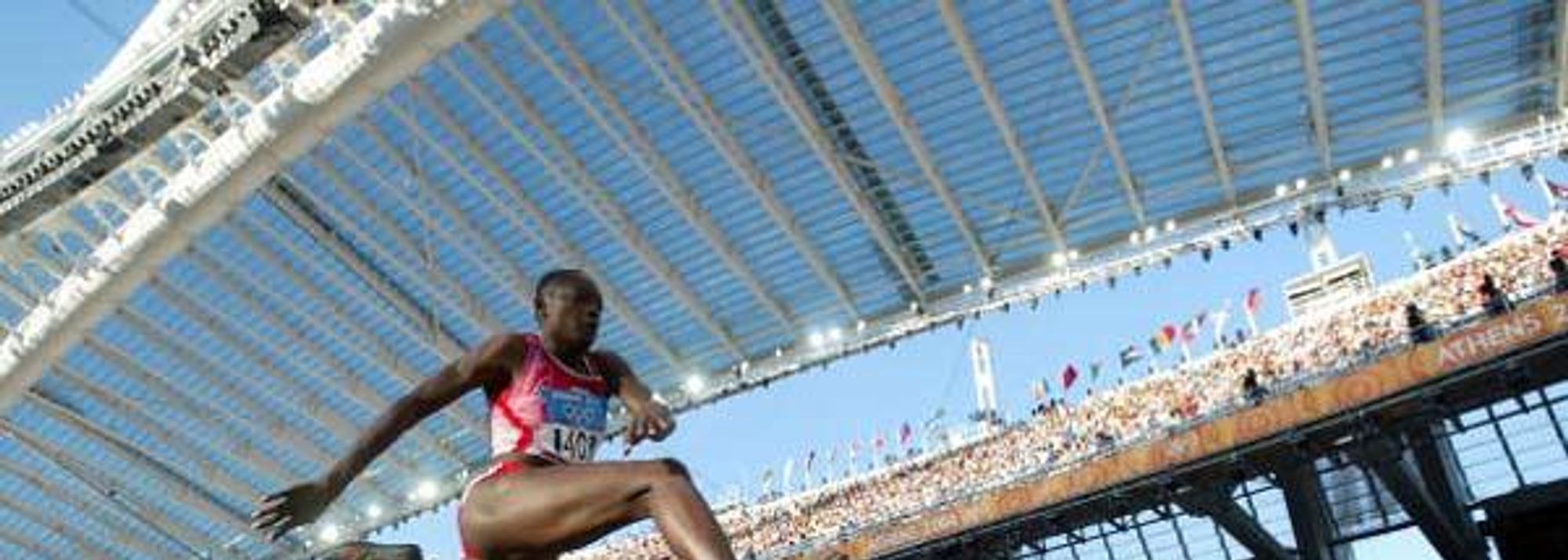


Françoise Mbango of Cameroon in the women's Triple Jump (© Getty Images)
Athens, GreeceTwo years ago, in front of a packed and shamelessly partisan crowd in Manchester, England, Francoise Mbango sat and watched as the Commonwealth Games Triple Jump gold medal was snatched away from her with the very last jump of the competition. By just four centimetres.
Mbango went through every athlete’s version of hell. She’d been so close to Cameroon’s first international athletics gold. Not that any of the 50,000 people watching took much notice. They were on their feet in wild and noisy celebration, for the woman who beat her was Ashia Hansen, the darling of British athletics.
Nervous wait
Last night, as the last round of the women’s Triple Jump final in Athens drew towards a close, the memories of that dreadful scenario must have played on her mind like a recurring nightmare. Mbango was in the lead again, her African record of 15.30 coming in the second round. But, again, there was a girl from host nation hunting her down.
Hrisopiyi Devetzi had set a Greek record in qualifying, one centimetre short of the Olympic record, and the Greeks turned out in their hordes to drive her on in the final, hoping for their second track and field gold of the day. Devetzi had been in second place since round three, and her best attempt was only five centimetres behind Mbango’s lead.
With her sixth jump the World champion Tatyana Lebedeva moved into bronze medal position. Then, with only Devetzi and Mbango to go, the judges halted the competition while the men’s 100m medal ceremony took place, prolonging the African’s agony. She paced up and down on the side of the runway and when the action resumed the announcer focused the attention of the entire stadium on Devetzi.
Magnificent series
As the Greek hit the sand the crowd roared. But at 14.92, it wasn’t enough. The gold belonged to Mbango, and Africa. Just for good measure, Mbango finished the competition by equalling her leading mark, concluding one of the finest series of women’s triple jumps ever seen. She had started with a foul, but it was a massive one, and followed with 15.30, 15.02, 15.17, 15.21 and 15.30 again.
“This is something I have been dreaming of,” said the ecstatic Cameroonian afterwards, dedicating her medal to “the whole of Africa”. “I knew I had a chance because I felt strong all year. I tried to stay below the radar so I could surprise the competition at this event,” said the 28 year-old who has competed in only two international meetings all year.
The strategy clearly paid off. All the pre-Games talk had been about Lebedeva, who had broken the World Indoor record three time when winning the World Indoor title in Budapest back in March. The Russian, a silver medallist in 2000, wanted to win an unprecedented long and triple jump double. After remaining unbeaten all year, some people assumed the triple was in the bag.
“Today it was my day to win”
After all, Mbango finished second to Lebedeva at two World championships, in Edmonton in 2001 and last year in Paris. She lost to Hansen again too, at the World Indoors in Birmingham in 2003, and must have wondered whether silver would always be her colour. Arriving in Athens though, Mbango felt different.
“The previous years I wanted to win, but I wasn’t ready,” she said. “I was too stressed and faced various problems. But this year I told myself that the most important thing is to win the Olympic gold medal in the place where the Olympic Games were born. Today it was my day to win.”
A national first
Her gold was the first medal ever for Cameroon in an Olympic track and field competition, the nation’s previous best being her own 10th place finish in Sydney. It will now rank up there alongside the Cameroon football team’s gold in Sydney as the country’s greatest sporting achievement, and like that triumph four years ago, she says, will help “to bring Africa closer to the world”.
“This is a chance to show my country and other Africans that athletics can bring the world together and that we need their support, just like they are doing with football,” she says. “I hope we can win many more gold medals in athletics and not have to go elsewhere to get the support we need to win them.
“This I something very good and important for Africa. If we don’t show now that we can win medals when are we going to have the Olympic Games in Africa?”
IAAF Development policy success
Despite being Paris-based these days, Mbango is clearly still passionately attached to her home continent. Indeed, her own road to glory is a story of success for the IAAF’s Africa development programme.
Born with a twin brother, Michael, in April 1976, Francoise Etone Mbango started in athletics as a 15 year-old, first competing at 400m before she discovered the triple jump. She was inspired by the experience of travelling to Paris as a teenager to compete in the Games of the Future, and has been training seriously ever since.
But her progress towards world class only really started when she moved to the IAAF High Performance Centre in Dakar, Senegal, in 1998, at the age of 22. At the time she had a best of 13.75, but immediately came under the wing of Anatoliy Golobutsova, the Russian coach who guided Ukraine’s Inessa Kravets to the World record 15.50 in 1995 (which still stands), and the inaugural Olympic title in Atlanta in 1996.
That year she won her first Commonwealth Games medal – almost inevitably, it was silver, behind Hansen. A year later she was 13th at the Seville World championships and set the first of her 14 African records. In 2000 she became only the second athlete from her country to compete at an Olympics – the first had been Gregoire Illorson, a 100m runner at the Moscow Games in 1980.
Move to France
At the end of that year she moved to France, to the north Paris suburb of Montreuil where she still lives and trains with her younger sister, Eseppo. She has not had a personal coach for more than a year.
“It has been very hard,” she said. “I have worked the entire time on my own, training just with my little sister. I use some of the schedules I learned from my old Russian coach, but I don’t have a band of staff around me like these other athletes do, I don’t have a physiotherapist, or any of that support.”
World record within reach
Mbango did acknowledge the support she had received from Cameroon’s national coach, Sylvaine Bissike, however. And Bisside revealed a little of what makes Mbango strong. “She believes in herself,” said Bissike. “And she likes it when the competition is hard. When she saw the Greek girl [Devetzi] break the record she said to me, ‘I am so glad. Now it will be a high level competition. That’s what I like’.”
Bisside believes Kravets’ World record is now within Mbango’s sights – “Did you see that first jump?” she says, smiling.
Back home in Cameroon the celebrations have started. “My phone has been ringing and ringing,” says Bissike. “There have been so many calls, from friends and family. Everyone is jumping for joy. They are so glad.”
Mbango has been jumping too, for Africa.
Matthew Brown for the IAAF


