

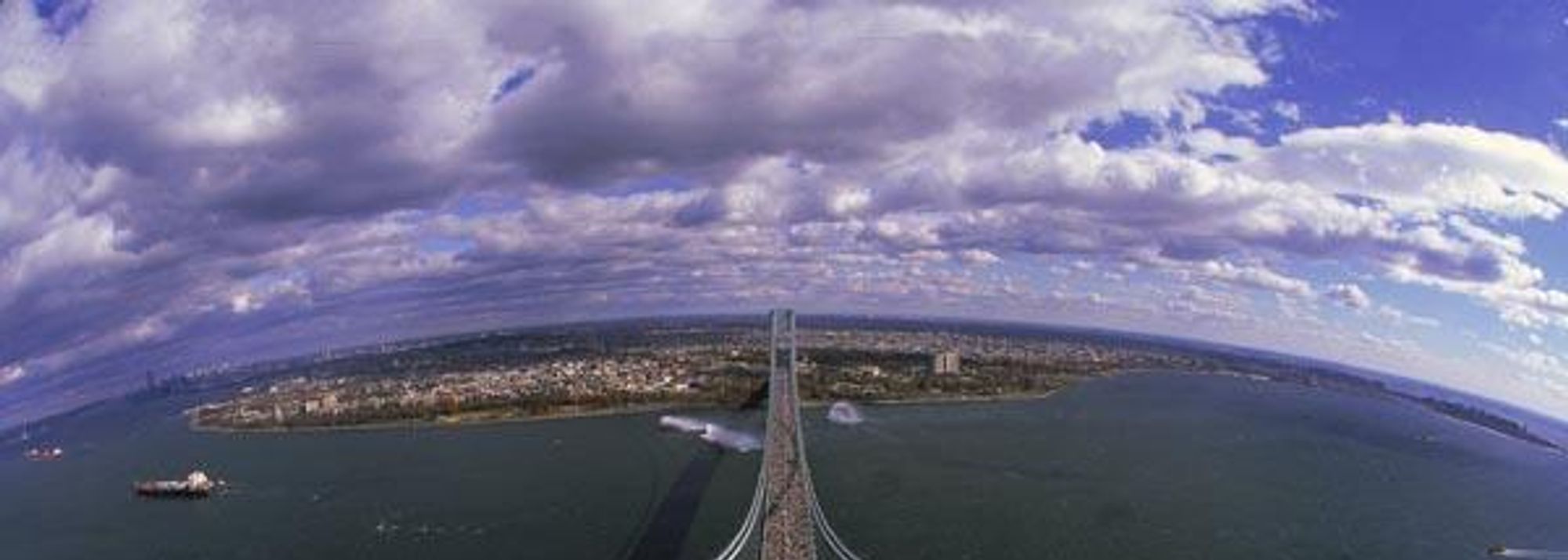


General View of the New York Marathon (© Getty Images)
The recent introduction of IAAF World records in road races is the latest proof, if needed be, that the discipline has definitely entered a new era. Paul Gains retraces the history of road racing around the globe
Massive fields numbering in the tens of thousands, cameras mounted on helicopters and trucks, scenic and accurately measured routes with full road closures, road racing has come a long way from the days when a few dozen hearty but peculiar looking souls lined up at the third telegraph pole past the church and raced a distance of questionable accuracy, for a cup of tea and a cold shower!
Today road racing is big business with corporate sponsorship an attractive means to promote a product. The ING New York City Marathon must limit entries to 30,000 runners who enter a lottery for the privilege of running the five boroughs. The Flora London Marathon attracts 40,000 runners annually and since its inception in 1981 has helped raise over £200 million for charities. That’s a lot of money and a lot of runners. Neither race is the world’s biggest though. That honour belongs to San Francisco’s Bay To Breakers which in 1986 had 78,769 registered runners plus another 30,000 bandits - people who didn’t officially enter.
As entry fees and sponsorship has flowed into the sport elite racers haven’t done too badly either. Prize money has risen to the level where more than a few can live quite comfortably from their efforts. New York offers $500,000 in guaranteed prize money for instance. On top of that there are bonuses based upon time. When Haile Gebreselassie broke the world 10km best running 27:02 in Doha, Qatar two years ago he earned a bonus of $1 million US.
Road racing has existed for centuries. A race known as the “Red Hose Race” was initiated by King James IV at Carnwath, Scotland in 1508. The Around the Bay Road Race in Hamilton, Canada is North America’s oldest having been run annually for 110 years at a distance of 30km. But it is only in the last thirty years that road racing has exploded internationally.
There are quite literally thousands of races of all distances held across the globe. Indeed, over 16,000 runners competed in the Great Ethiopia Run, a 10km race organised by Gebrselassie to spread awareness of HIV/AIDS. Road Racing is a sport unto itself and the sport governing bodies have reacted accordingly.
As of January 1st of this year the IAAF recognises World records at standard road race distances of 10km, 15km, 20km, half marathon, 25km, 30km and the full marathon. That’s welcome news to race organisers, athletes and sponsors. There is also the possibility that a World Championship race will one day be contested over 10km. The IAAF has been organising a World Half Marathon Championships on an annual basis since 1992. This year’s edition is to be held in New Delhi in September.
Road racing was once a poor cousin to track racing but now there are athletes who will never venture onto a track, except perhaps to finish a marathon. Many experts agree that the acknowledgement of World records is a giant leap.
“Having World records now is good for the sport and for the individual athletes,” says Jos Hermens, universally known as Haile Gebreselassie’s manager but who was a pretty good runner in the 1970’s. “Now you can explain to the outside world the times for 10km, half marathon because they run these distances themselves and now they know how fast people run.”
“In our day you could win a couple of thousand dollars - people like (Dave) Bedford, Frank Shorter or myself. That was about the highest. I know I was going to run the New York Marathon in 1978 and (race director) Fred Lebow said he would give me one thousand dollars to run NY. Nowadays when you run your first one you probably have to run for free anyway.”
Hermens remembers competing on the roads when there were very few races and very few competitors. When he planned an assault on the World one hour record in 1976 he organised the event himself and sold tickets. He reckons he earned the princely sum of $6,000 as runner/promoter that day for what was the World record of 20.944 Km. His result on that day remains the European record. Essentially, road racing was a distraction, amusement perhaps, when the track season was over. Hermens points to athletes such as Sammy Korir who trains in Kenya year round leaving two or three times a year to compete in city marathons where he will earn hundreds of thousands of dollars.
As a race director himself - Hermen’s Global Sports Communication company organises a handful of renowned road races including the Rotterdam and Cleveland marathons - he has watched the sport grow considerably. He puts it down to the fitness boom of the 70’s when people discovered the ethereal qualities running can bring.
Frank Shorter’s gold medal victory in the 1972 Olympic marathon is widely regarded as the catalyst for the North American running boom of the mid-70’s. But Shorter, who is now the Chairman of the U.S. Anti Doping Agency humbly defers credit.
“I am willing to acknowledge that I played a role but there were also other things going on,” Shorter says from his home in Boulder, Colorado, “I wanted to stay in the sport and figure out a way to make a living as a runner. It also happened to be at the same time in history that Roone Arledge of ABC sports decided to feature the marathon in the olympics.”
“You can’t discount the medical science. The first true research results were starting to come in on the true benefits of exercise. Up until 1960 someone could say "prove to me that working out is good for me. Prove to me it’s not bad for me." And really you couldn’t do that.”
Shorter remembers his first road race being the 1970 Springbank International12 miler in London, Canada a race that attracted other luminaries of the day such as Karel Lismont, Ron Hill, Jerome Drayton and even Olympic 5,000m and 10,000m champion Miruts Yifter. Like other track stars Shorter would sometimes race on an Italian road race circuit following the European track season. Not having to constantly compare personal best performances made the roads even more enjoyable to these athletes.
As the running boom flourished on both sides of the Atlantic many race promoters entered the sport some to capitalise on the financial potential but many to help the sport further grow. Under the guidance of the late Fred Lebow, the NewYork Road Runners Club set about organising races in Central Park. Alan Steinfeld, the current President of the organisation, began as a volunteer under Lebow and has watched the club grow along with the sport. According to Steinfeld, who also directs the New York City Marathon, the club now has 40,000 members, and employs 65 full time employees. The NYRRC organises more than 70 road races each year!
“There’s been tremendous growth in our road race participation but there has been exponential growth in women’s running especially in the 20 - 29 age bracket,” Steinfeld reveals. “Women aren’t getting married as young and they are not having kids as young so they are more into taking care of themselves. “
“Our office overlooks central park and we see women running in the park before work, after work and on lunch hours. Our membership is 40,000 and in the age 20-29 we have 6,000 women and 2,000 men. Even with the winter we have been having we have had to change our races in central park to fun runs and even then we have had 2,000 runners.”
So as we enter a new era where road race records are maintained by the IAAF statisticians we can look at a pattern that has evolved. Most of the records are held by athletes with outstanding track credentials who have moved to the roads on a consistent basis.
Paula Radcliffe shattered the World marathon record in London running 2 hours 15 minutes 25 seconds. The European 10,000m record holder and World 10km road record holder, she possesses formidable speed for the longer distances. Amongst the men it is Paul Tergat twice the Olympic silver medallist at 10,000m and a former World record holder at that distance, who dominates the record book. His 20km record of 56:18 set on the fast Stramilano race course in Italy five years ago is simply outstanding but of course he is most recognised for the marathon World record of 2:04:55 he set in Berlin.
As more and more track athletes turn their attention to the lucrative road racing circuit we can only expect times to drop and more attention paid to the sport. Who knows? Perhaps we will even witness another running boom. And that would be good news for all concerned.
Published in IAAF Magazine Issue 1 - 2004

